

Stop Doing These 12 Things in Your Rulebook
Know what to look for to make your rulebook communicate clearly.

Still writing your rulebook? Go check out my companion piece for rulebook structure and thought processes:
How to Write a Rulebook for Your Board Game

Rules can feel hard to write. They have to make a game feel understandable to the reader, clarify your intentions, and make sure players feel like they know what they're doing. It's a weird blend of technical writing that shouldn't sound like technical writing.
Between editing dozens of rulebooks for other designers and writing many more of my own, I’ve been really impressed with the many different styles of formatting, writing, and general organization. The more rulebooks you see, the more you’ll see what they have in common.
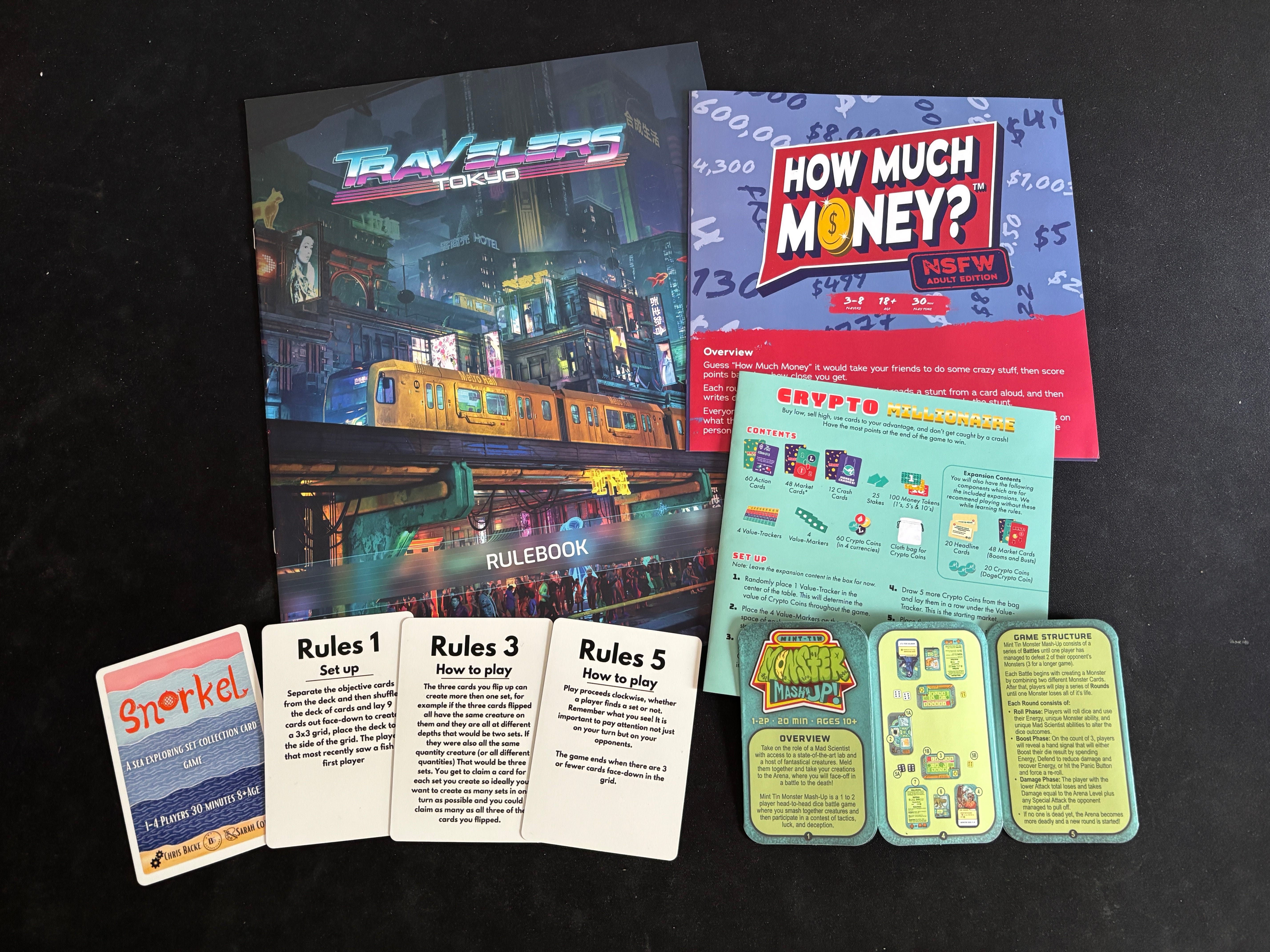
The rulebooks from some of my published games.
There is no One Format To Rule Them All, but there a lot of easily correctable things you might find in your rulebooks (and yes, I’ve found many of these in my own rulebooks at one point or another).
1. Forgetting how people read rulebooks
Think about the last few published games you played where someone read the rules from the rulebook. Did you read the rulebook completely through before you started playing?
I’d bet you got through setup, talked through a turn, then aimed to set the rulebook aside and play. Whenever people had a question, they probably flipped through the pages, scanned the headlines, sidebars, or bolded text to find the answer. They found it, read it out loud, then hopefully got on with play.
The other time rulebooks feature prominently is when a player returns to play it a second or third time, but it’s been a minute.
I’ve come to really admire the thought process behind the Exploding Kittens games. Yes, they’re simple games by design, and the box design makes it sound simple as well (which itself is a great way to design for the mass market):
2. No visual examples or sidebars
You already know to avoid the dreaded ‘wall of text’, and paragraph breaks are easy enough… but it can’t just be text.
Think about the parts you’ve found difficult to teach during a playtest, or the parts that feel clunky to explain. Sketch out what’s happening, what’s moving, or what players have been missing. Think about showing the progressions or order of operations.
Best practice: when the rulebook reaches the stage where someone else is going to see the rulebook but I’m not teaching the game, it needs visuals.
3. Burying how to win
Players read rules through the lens of two closely-related questions: ‘how do I win?’ and ‘how does the game end?’. If the answers don’t show up until page 4, everything before it lands without context. The reader has no way to judge whether an action is good, bad, or worth remembering.
Mention how you win as early as possible in the first paragraph, in plain language. Bonus points if you can combine them: ‘The player with the most points after 7 rounds wins’ does more work than three paragraphs of setting. Your reader can now file every rule that follows under ‘this helps me win’ or ‘this stops my opponents’.
4. Using thematic terms before mechanical ones
Your rulebook says ‘the Archmage may banish one Familiar per turn’… but what’s the Archmage and what’s a Familiar?. Your reader has no idea the Archmage is their pawn and the Familiars are opponent tokens. Thematic terms feel evocative to you because you’ve lived in this world for months. To a first-time reader, they’re a second language layered on top of the rules they’re trying to learn.
Anchor every thematic term to a mechanical one the first time it appears: ‘your Archmage (your pawn)’. Better yet, pair terms throughout – Resource tiles, Scoring tiles, Action cards, etc. It might be the ‘boring’ name, but it’s the one that actually teaches the game.
5. Calling the same thing by different names
What happens when page 2 calls it a ‘discard pile’, page 5 calls it a ‘scrap heap’, while page 7 casually mentions ‘the trash’? You know they’re the same pile, and while your reader might infer they’re the same thing, they shouldn’t have to guess.
Pick one consistent term per component and per action, then build a mini style guide as you write. For me, this is usually one of my dry erase boards that’s propped up, but use whatever is easily updated and seen. Whatever it is, check it as you update the rules. Consistency here is worth much more here than clever variety.
6. Writing long sentences that need two breaths to speak
Before: ‘On your turn, after drawing a card from either the main deck or the discard pile, you may play up to two cards from your hand, unless you played a Storm card last turn, in which case you may only play one, and then discard down to five cards.’
Ugh.
Anything this long is both difficult to say and difficult to follow. Shorten the sentences and avoid combining the rule with the exception.
After: ‘On your turn, draw 1 card from the main deck or the discard pile. Play up to 2 cards from your hand. (If you played a Storm card last turn, you can only play 1 card.) When done playing cards, discard down to 5 hand cards if needed.’
The one-breath rule from my earlier post applies here: if you can’t speak the sentence in one breath, split it into smaller sentences. The order of operations should read like steps, since that’s how players will execute them.
7. Making players jump around the book
You’re writing a rulebook, not a treasure hunt or a Choose Your Own Adventure book.
‘Resolve the market phase (see page 6)’ followed two lines later by ‘then check for the Herald bonus (see page 9)’ turns your rulebook into a treasure hunt. Every jump breaks the reader’s flow and their confidence that they’re playing correctly.
Explain things in the order players need them. What do they need to know, and when do they need to know it? If a rule genuinely belongs elsewhere, ask whether it could live in a sidebar right where the question comes up instead. The one jump that makes sense is the ‘End of round’ section pointing to the ‘End of game’ section, but even then they’re usually right next to each other.
8. Explaining edge cases before the basic rule
Some designers are so worried about ambiguity that they front-load the exceptions: ‘Move your pawn up to 3 spaces. If a space is occupied by 2 or more pawns, and it is not a Sanctuary space, and you have no Boots tokens, you may not enter it.’ The poor reader hasn’t even taken a normal turn yet.
Teach the normal / typical case first, then place each exception directly next to the rule it modifies. Frame it as an ‘if-then’ sort of statement: ‘If you end your turn with more than 7 cards in your hand, discard down to 7.’ Edge cases handled where they occur means fewer questions down the line.
9. Letting flavor interrupt the flow
A joke in the middle of the setup instructions costs more than it gives. The player reading your rules for the first time feels like they’re working, and every sentence that isn’t teaching is friction. The player checking a rule mid-game, with three friends waiting, probably resents your pun about goblins.
Flavor still has a home, but it should be clear what’s flavor and what’s important. Sidebars, the intro paragraph, and card text can all carry story beautifully without slowing the teach.
If you want to imbue some flavor in a section, start the section with a short, italicized paragraph before jumping into the rules:
You never know who’s gonna show up at the castle after dark, after all. Keep your defenses up and the portcullis down and you should be fine.
Bonus points if your flavor text has a different style / tone of voice to further distinguish it. If you have a prominent character in the game, have the flavor come from them.
10. Using the passive voice
Before: ‘Cards may be discarded at any time, and points are awarded when sets are completed.’
After: ‘Discard cards at any time. When you complete a set, score its points immediately.’
Using the passive voice hides who’s doing what, and rules exist to tell specific player(s) to do specific thing(s). Lead with verbs whenever you can. As a bonus, active sentences are typically shorter, which helps with point #6.
11. Repeating rules in multiple places
State each rule once in the place players need it. Repeating yourself doesn’t make things clearer. If you’re not sure of a rule’s best place, ask your playtesters. When does it most help them, and is it easier to understand ‘A, then B’, or ‘B, then A’?
12. Using a ‘Frequently Asked Questions’ section
This isn’t meant as a spicy take, just reality. Why is this a frequently asked question? If you’ve heard the same question come up frequently, take a moment to identify when it’s being asked and why. It might be easy enough to add a graphic or callout to the appropriate space on the map. Better still, move that info earlier to a more appropriate space in the rulebook.
Want a second opinion on your rulebook?
You probably know I do editing and proofreading, but I’ve recently started offering a ‘rulebook audit’. This covers dozens of questions, points out what’s working and what isn’t, then steps back to let you fix things your way: