Designer Diary: Rooftop Roses
Dice rolling, area controlling, rose planting, print-and-playing

Take one basic mechanic, one twist from playtesting, one common sheet, a couple of other things… et voilà!

Rooftop Roses started out in January 2026 as my entry into our first PnP Bundle (which arrives to Gamefound on July 21, 2026 - follow, back, or get the late pledge depending on when you’re reading this).
I had several self-given goals / constraints when putting this together:
It needed to be a low or no assembly print-and-play
It needed to be a stand-alone sort of game (there are 2 other games in the print-and-play bundle, and each of them would be its own stand-alone experience without a ton of add-ons / different ways to play)
It needed to work as a solo game and a multi-player game
It needed a minimal ‘ask’ of printing and components
I had a couple of other ideas around the same time as this one, but I liked the simplicity of this core loop the best:
Roll 3 dice
Use 2 dice to make 1 mark in an empty square at the intersection of those 2 numbers.
Use the remaining dice to… do… something else…
The first version of central sheet started very mechanically:
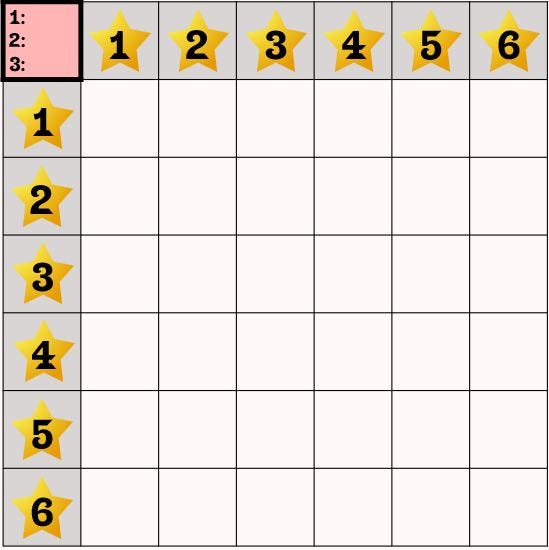
Whoever had the most marks in the row or column would score that many points.
The first ability sheet had six different abilities, based on your remaining die:
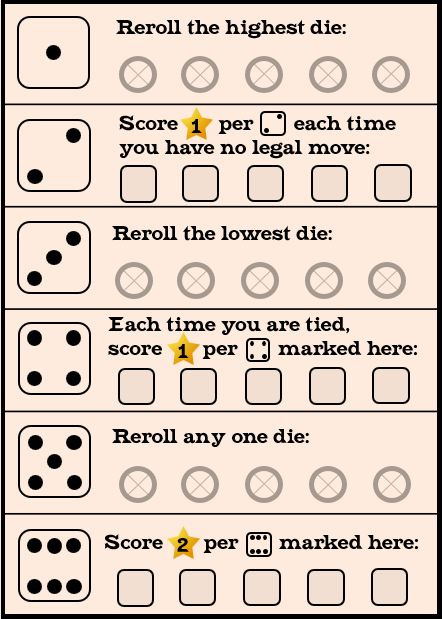
A few things became quickly obvious:
No one spent much time trying to win the top row or leftmost column for a whopping 1 point, especially since there was no way to make it worth more.
There was some analysis paralysis in considering which powers you wanted, and when you should use them – more than I wanted in a casual / family-friendly dice-rolling print-and-play.
The heuristic was too simple: just go for the highest two numbers since those rows / columns were worth the most points. (The higher numbers powers were better, but it was easier to see the points on the board.)
A bit of math presented an opportunity: whenever you roll 3 six-sided dice, you have a 41.67% chance to roll doubles and a 2.78% chance to roll triples (3 of a kind). This made way for a new scoring sheet with a few rule twists:
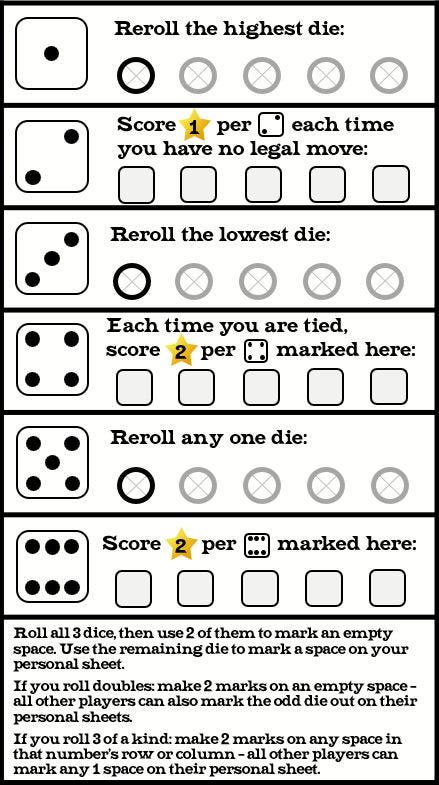
You now had the chance to make 2 marks in an empty space, but doing so gives other players another power. You also had the power to manipulate your way into doubles or out of doubles. 3 rerolling powers felt a little samey, and 3 extra ways of scoring points was still a little too much to comfortably hold in your hand.
I also self-playtested a few new scoring systems on the common sheet:
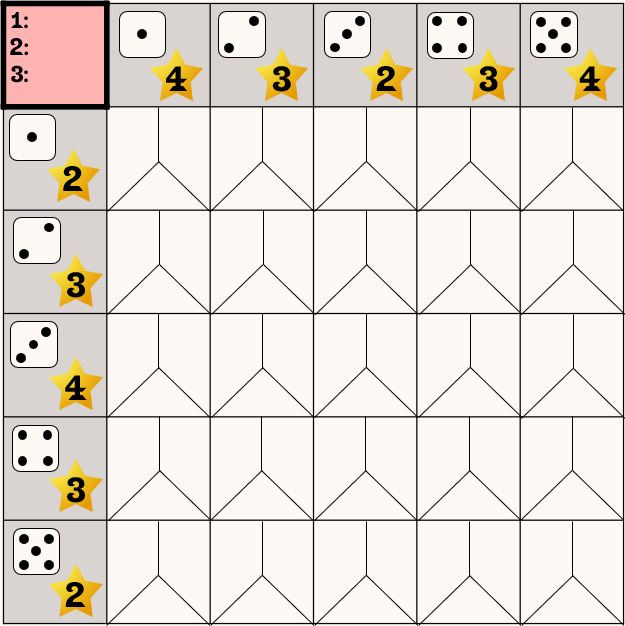
6’s were wild, and making the rows / columns worth 2, 3, or 4 points narrowed the scoring range a bit… and showing the maximum number of marks in a space made it easier to track whether you could go there or not…
It’s worth pointing out most of the core loop and the end of the game has been essentially unchanged since version 1. If you cannot make a legal move, mark one of the spaces in the upper left corner. The game ends immediately when the third mark is made.
A breakthrough
The biggest breakthrough was deciding to make the leftover die matter in a new way: cross out the lowest-numbered star in the leftover die’s row or column to make it worth another point:
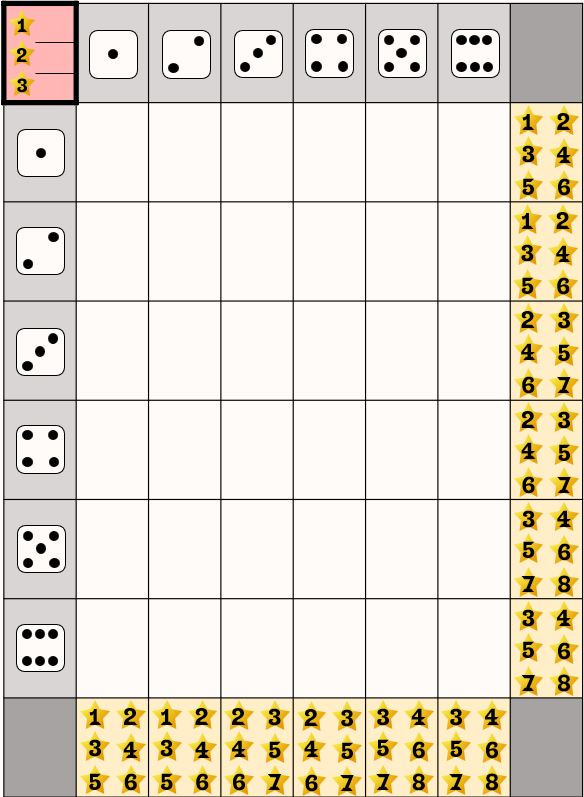
Sure, those higher-numbered rows / columns are worth more at the start, but it means you’ll probably be boosting the lower-numbered rows / columns… which means they can be worth more by the end of the game… It also gave you a reason to consider whether it was better to choose the intersection first or where you wanted to boost.
After some feedback that simply marking the corner felt like a wasted turn, I added some points as a consolation prize of sorts. That they were guaranteed points felt better, though they got a small buff in a later version.
A couple of iterations on tiebreaking rules later and I had that sorted: control the row / column to score points, but if there’s a tie, look to see who boosted that row / column the most.
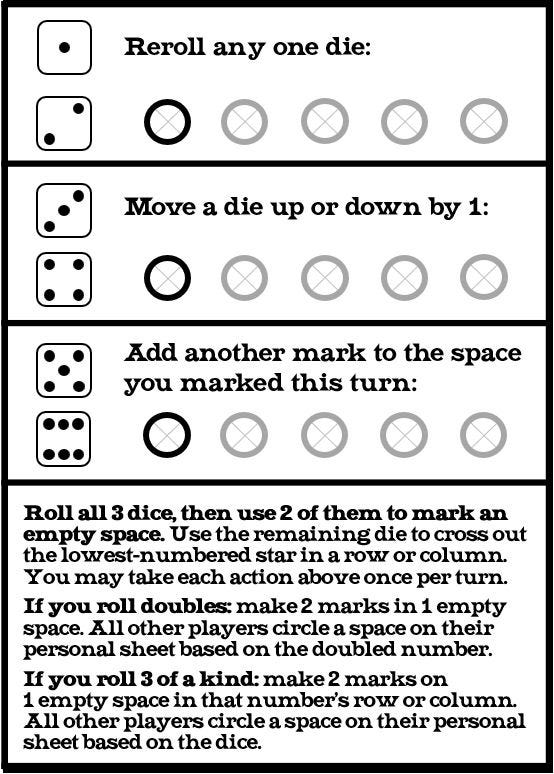
The scoring sheet needed another few playtests to find the right balance of manipulation, but also to confirm a rule change: you’ll start with one of each power, but the only way to get more was when other players used their doubles or triples to make two marks:
Retheming to rooftops and roses
A few themes were suggested by playtesters: gold prospecting, constructing buildings along the grid of city streets, mushrooms in a forest and garden plots of some sort.
I liked the idea of garden plots and communal gardens, then thought of some unusual places for them. England has plenty of allotments, but I loved the idea of a communal garden in a very urban environment. What to plant in those communal gardens? Vegetables seemed fairly cliché, but flowers came in most colors of the rainbow… roses are iconic and conveniently alliterative to ‘rooftop’, so away we went.
I have Parker Simpson (my illustration partner on many other print-and-play games) to thank for bringing the 75th floor roof to life: