

Custom Games
A board game built around your brand, your team, or your world.
Most organizations don’t need a generic team-building exercise. They need something that works – something that people actually want to play, that teaches what it’s supposed to teach, and that reflects the brand or vision behind it. A custom game delivers all three, and it lasts longer than a workshop, a webinar, or a branded stress ball.
What kind of game are we talking about?
Custom games aren’t just one thing:
Brand and marketing games: a game that puts your product, service, or brand in players’ hands in a way that’s genuinely entertaining rather than a thinly veiled ad.
Team-building and training games: a game that teaches soft skills, compliance topics, onboarding content, or company values through play. People retain more when they’re engaged, and they’re far more engaged when there’s a game in front of them.
Giveaways / merch / swag: something memorable that clients or partners actually keep, rather than throw away.
Educational and professional-use games: for classroom settings, conferences, workshops, or industry training where the goal is learning through doing.
Games that bring a creative world to life: authors, IP holders, and content creators who want a game that introduces new audiences to their work while rewarding existing fans.
Whatever type of custom game you’re looking at, your game is designed from scratch around your specific brief, not adapted from a template.
Case study: The Listening Path
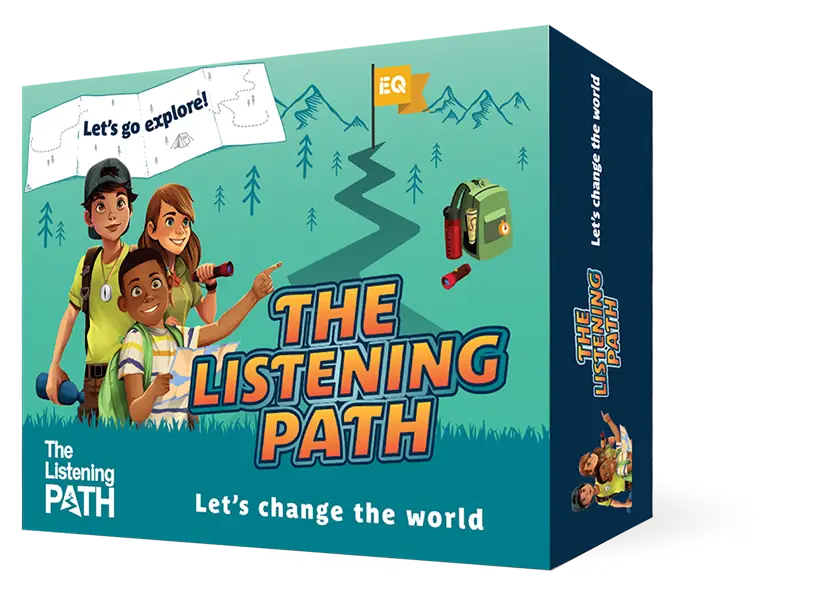
Christine Miles had a proven methodology for teaching listening, built over years of professional workshops and documented in her book. She needed someone to turn that methodology into a board game for classroom use — one that was educational enough to be credible and fun enough that people actually wanted to play it.
We worked through the design in virtual sessions: establishing the core experience, sequencing activities to track the methodology, and making sure nothing was abstract enough to confuse a first-time player. As Christine’s team produced component drafts, we iterated on presentation and clarity at each stage. The game is now Patent Pending.
“Chris’s expertise was critical to being able to convert my vision into a game that was fun and incorporated all that is necessary to make it easy to play. I couldn’t have done it without him.”
— Christine Miles, The Listening Path
Case study: Bringing an author’s world to life
[Note: this project is in the art stage and hasn’t been officially announced — this section will be updated once it’s public.]
A full-time author with an established series commissioned a board game set in the world of their book.
The brief: a game that would serve as an introduction to the books for new readers while rewarding existing fans with recognizable details. I read the full series (some of them more than once) to get the details right, then worked with the author and their team to design a game that captured what their audience would actually enjoy.
A fan of the game becomes a potential fan of the books, and vice versa. That’s the value proposition for an IP-based custom game done well.
What’s included
Custom game projects are quoted individually, but the core scope typically covers:
Design and development: the game itself – mechanics, structure, rules, playtesting, and iteration until the game actually works as intended.
Art direction and illustration: if you have an existing artist or internal creative team, great. If not, I can source the right illustrator for your project and manage that relationship.
Manufacturing: I work with manufacturers experienced in board game production to produce your preferred number of copies. If you have your own manufacturing facilities or preferred supplier, that’s straightforward to accommodate.
Files and licensing: once the project is complete, the design, artwork, and components are yours. Put your name on the box. Sell it, give it away, use it in-house — the license is yours to do with as you need.
Project management: tying everything you see below together.
Pricing and timelines
Packages start at £1,000. Most projects are quoted between £3,000 and £10,000.
The final figure depends on three things:
Design scope: how complex the game is, and how much iteration is needed to get it right.
Art and illustration: how many assets need creating, and at what level of detail.
Manufacturing: how many copies you need, and what the per-unit cost works out to for your chosen format and component mix.
Ordering additional copies after delivery is straightforward once the files are ready. As you might expect, the per-unit cost drops significantly at higher quantities.
A 33–50% deposit starts work. Additional milestones can be agreed on for larger projects, with the balance due on delivery.
Lead time: from first contact to games at your door can be as short as three months for simpler projects. Most projects run around six months. You can be as involved or as hands-off as you prefer throughout.
Start with a free discovery call
Let’s sit down and have a 60-minute conversation about your project: what you want the game to do, who it’s for, what constraints you’re working within, and so on. This is your chance to ask questions, bounce ideas back and forth, and learn how it all works.
Case study: A mini-game within an existing game
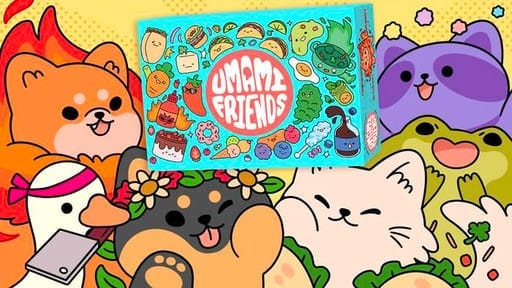
Andrew Jack commissioned a mini-game for Umami Friends — the brief was to design a standalone variant using only the cards and components already in the base game. The result was an I-split-you-choose mechanism with secret set collection, built entirely around the existing art and component set.
Sometimes the most elegant solution works within constraints rather than around them.