

Consulting
Get one-on-one advice from someone who’s been through the whole process.
I offer three focused types of meetings – Creative, Development, and Presenting – each aimed at a specific stage of your game’s development. You leave with a clear next step, not a list of things to think about. $50 for a one-hour session:
Want to craft something custom-made? Just let me know what you’re looking to cover =)
Creative

For when something in the game isn’t working – and you can’t see it anymore.
After 50 or 100 plays of your own game, you lose the ability to see it clearly. You know exactly how it works, which means you can no longer see where it confuses people, drags, or breaks down. A Design Session brings in a second set of eyes – someone who can engage with your game cold, diagnose what’s happening, and give you the kind of developmental feedback that’s actually different from “I liked it” or “it was fun.”
This isn’t playtesting. It’s focused work on the design itself – the core loop, the decision space, the feel, the hook.
What we can cover:
The core loop and decision space – where the interesting choices are, and where there aren’t enough of them
Math, probability, and balance – when your gut says something’s off and you need the spreadsheet to prove it
UI/UX – component layout, iconography, information hierarchy; if players are confused, this is usually why
Finding the hook – the single thing that makes your game worth pitching, and how to make that thing central rather than incidental
Mechanics theory and application – why a specific mechanism is or isn’t working, and what to replace it with
Scope: when to cut, what to cut, and how to stop scope creep from turning a 6-month design into a 4-year one
Who this is for: Designers at any stage – early concept, mid-development, or somewhere between “this works” and “this is good.”
Format: 60-minute sessions, booked online.
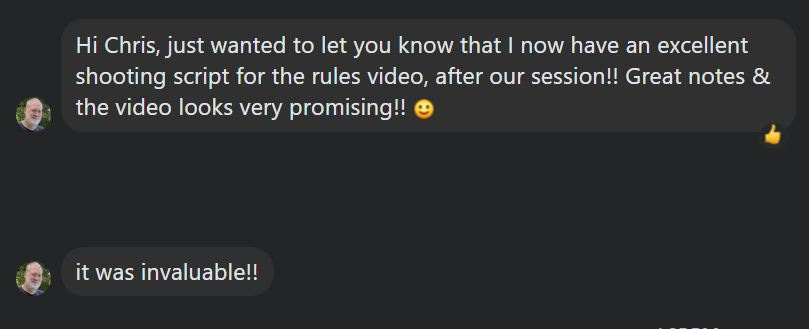
“At every turn, he helped address my needs and ideas, and found ways to get me to reflect on areas and questions I hadn’t originally considered, showcasing his expertise and creativity.”
– Isaac Grillo, game designer
Development

For when you’re getting feedback, but it’s not moving the game forward.
Playtesting isn’t usually the hard part. Running a playtest that produces useful data – that’s the hard part. Most designers playtest constantly and improve slowly, because they’re gathering impressions instead of information. Playtesters say “I liked it” and “it dragged in the middle,” and you don’t know which 40% of the game they’re reacting to.
A Development session is specifically about the process of getting better feedback, not just more of it.
What we can cover:
Designing a playtest session with a clear, answerable question – not just a general vibe-check
Who to playtest with (and who to stop inviting – “my wife says it’s good” testers)
How to run a blind playtest and what it will actually tell you
Observation techniques: how to watch a playtest without interfering with it
What questions to ask playtesters, and when to ask them
Separating “I didn’t enjoy this” from “this doesn’t work” – two very different problems
Tabletop Simulator: importing your game, setting up remote sessions, and getting useful feedback from virtual playtests
Turning a debrief into a development roadmap instead of a pile of notes
Who this is for: Designers who are playtesting regularly but aren’t sure how to act on what they’re hearing – or anyone preparing for a major testing push before a pitch or Kickstarter launch.
Format: 60-minute sessions, booked online.
“Your meeting was extremely insightful and proved to give me tons of helpful pointers, making my journey as a developer much more clear. I feel like I dodged bullets and got refined direction from you.”
– Brett Trout, game designer
Presenting

For when the game is ready, but the pitch isn’t.
Some designers spend two years on a game and two weeks on the pitch. The pitch is where deals are made or missed, and it requires a completely different set of skills. Knowing how to design a tight engine-builder does not automatically tell you how to write a sell sheet, how to find the right publishers for your specific game, or what to say in a 10-minute pitch at Gen Con.
The pitch workflow – sell sheet format, submission etiquette, response timelines, the difference between a soft pass and a real no – is learnable with the same rigor you applied to the mechanics. It’s just that nobody teaches it as a system.
What we can cover:
Publisher research: which publishers are currently acquiring, what they’re actually looking for, and how to build a submission list that makes sense for your game – not just whoever’s biggest
Sell sheet structure and what publishers actually want to see, with real examples
Understanding the publisher-designer relationship before you sign anything: escalating royalties, advances, reversion clauses, the difference between 7% on MSRP and 7% on net
Practicing the pitch itself: what to lead with, how to handle “what’s the hook,” and what to do when they say they’ll think about it
Reading a pass: what “not a fit right now” actually means, and when / how to re-approach
Rulebook presentation: publishers form opinions about your game from the prototype and the rules; both need to be clear
Who this is for: Designers with a game that’s close to pitch-ready, and anyone who’s been pitching without success and wants to figure out where the process is breaking down.
Format: 60-minute sessions, booked online.
“We just hired Chris to consult with us before we start pitching our game to publishers and it was a big help. Chris gave us a lot of helpful advice on focusing our materials more toward what publishers actually want to see.”
– Luke Daughtry, Game Designer of Standoff (Enter the Box Games)
Kind words from previous clients
“I think direction was the real value. Actions I can take are always more helpful than ideas.”
– Taylor Hayward, designer of Dawn
“Chris has a wide breadth of game knowledge and an excellent eye for quality game mechanics. He was very comprehensive with the feedback he gave, and he’s extremely easy to work with.”
– Ryan K., game designer
“We were new to the games industry and had a lot of questions. Chris was both informative and supportive. Would recommend.”
– Dominic Ellis & Conor Davids, designers of Blytz
Are you under 18 (or a parent of an under-18 designer)?
I love chatting with kids about their game ideas! As time allows, I’m happy to meet you virtually for up to an hour for free - feel free to introduce yourself and your project via email: chrisbacke AT gmail DOT com. This is my way of giving back to the community of game designers that have helped me along my own way.
Parents, you are welcomed and encouraged to sit in.